your friend, jamie, rolled a number cube and got the number 5. on his next turn, he says he wont be able to…
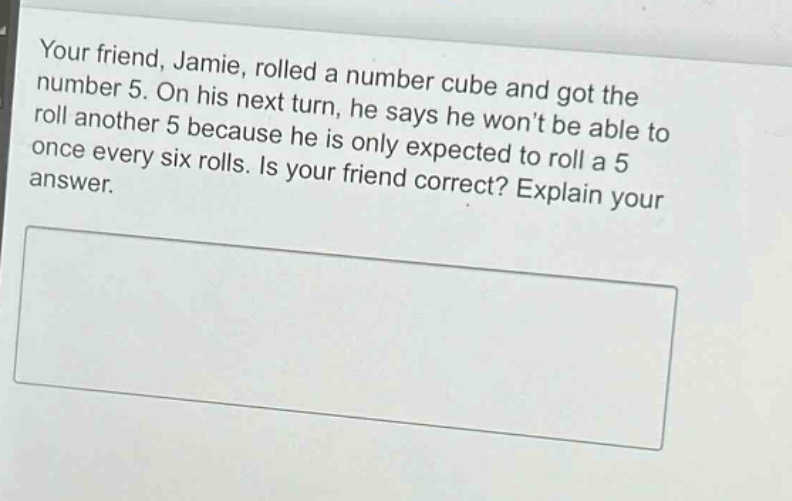
your friend, jamie, rolled a number cube and got the number 5. on his next turn, he says he wont be able to roll another 5 because he is only expected to roll a 5 once every six rolls. is your friend correct? explain your answer.
Answer
Explanation:
Step1: Understand probability concept
Each roll of a number - cube is an independent event.
Step2: Analyze probability of rolling a 5
A standard number cube has 6 faces numbered 1 - 6. The probability of rolling a 5 on any single roll is $\frac{1}{6}$. Just because the expected number of times to roll a 5 is once every 6 rolls on average, it doesn't mean that after rolling a 5, it can't be rolled again on the next turn.
Answer:
No, your friend is not correct. Each roll of the number - cube is an independent event, and the probability of rolling a 5 on any single roll is $\frac{1}{6}$, regardless of previous rolls.