your teacher is giving out fruit for lunch. a paper bag contains 4 apples, 6 pears, and 8 oranges. what is…
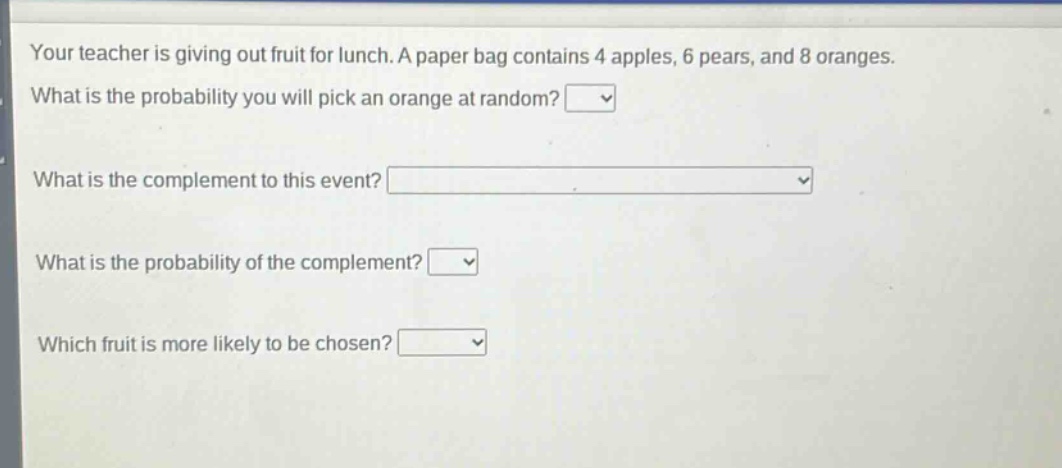
your teacher is giving out fruit for lunch. a paper bag contains 4 apples, 6 pears, and 8 oranges. what is the probability you will pick an orange at random? what is the complement to this event? what is the probability of the complement? which fruit is more likely to be chosen?
Answer
Explanation:
Step1: Calculate total number of fruits
$4 + 6+8=18$
Step2: Calculate probability of picking an orange
The number of oranges is 8. Probability $P(\text{orange})=\frac{8}{18}=\frac{4}{9}$
Step3: Define the complement event
The complement of picking an orange is picking an apple or a pear.
Step4: Calculate probability of the complement
The number of apples and pears is $4 + 6=10$. Probability $P(\text{not orange})=\frac{4 + 6}{18}=\frac{10}{18}=\frac{5}{9}$
Step5: Compare probabilities
Since $\frac{4}{9}<\frac{5}{9}$, and $\frac{4}{9}$ is the probability of picking an orange and $\frac{5}{9}$ is the probability of picking an apple or a pear, apples or pears are more likely to be chosen.
Answer:
What is the probability you will pick an orange at random? $\frac{4}{9}$ What is the complement to this event? Picking an apple or a pear What is the probability of the complement? $\frac{5}{9}$ Which fruit is more likely to be chosen? Apples or pears