zamari has a spinner with equal sections red, blue, yellow, green, and orange. he says that the theoretical…
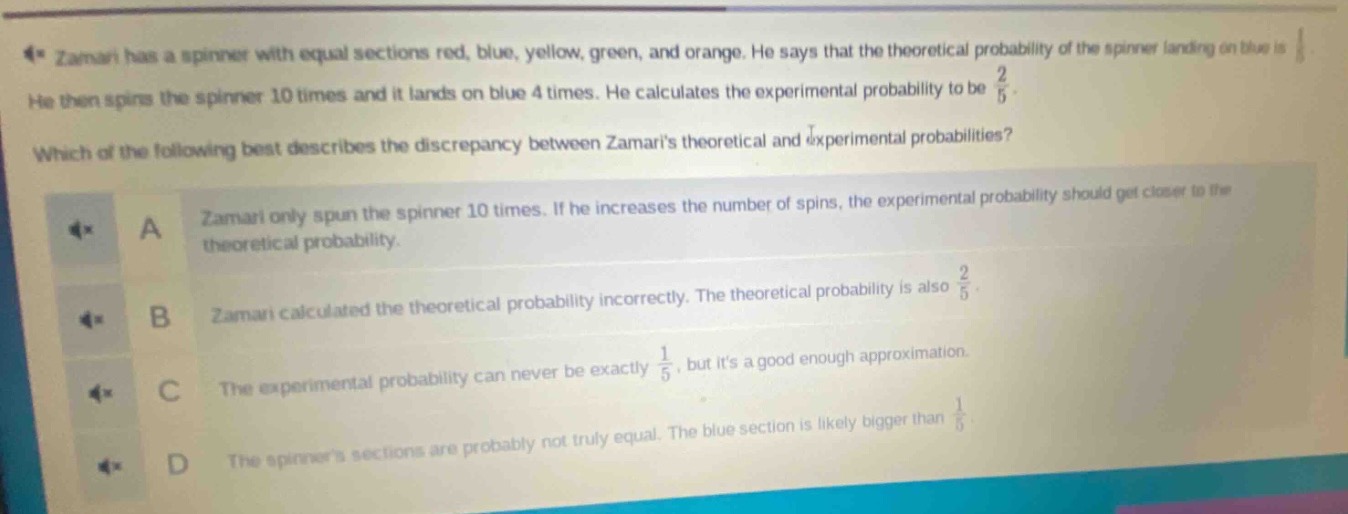
zamari has a spinner with equal sections red, blue, yellow, green, and orange. he says that the theoretical probability of the spinner landing on blue is $\frac{1}{5}$. he then spins the spinner 10 times and it lands on blue 4 times. he calculates the experimental probability to be $\frac{2}{5}$. which of the following best describes the discrepancy between zamaris theoretical and experimental probabilities? a zamari only spun the spinner 10 times. if he increases the number of spins, the experimental probability should get closer to the theoretical probability. b zamari calculated the theoretical probability incorrectly. the theoretical probability is also $\frac{2}{5}$. c the experimental probability can never be exactly $\frac{1}{5}$, but its a good enough approximation. d the spinners sections are probably not truly equal. the blue section is likely bigger than $\frac{1}{5}$.
Answer
Brief Explanations:
Theoretical probability is based on the nature of the event (1 out of 5 equal - sections for blue, so theoretical probability is $\frac{1}{5}$). Experimental probability is based on actual trials. With a small number of trials (10 spins), the experimental probability can deviate from the theoretical probability. As the number of trials increases, the experimental probability should approach the theoretical probability.
Answer:
A. Zamari only spun the spinner 10 times. If he increases the number of spins, the experimental probability should get closer to the theoretical probability.