what is the most effective way to combine sentences 1 and 2 into an effective hook? a in \fear of change,\…
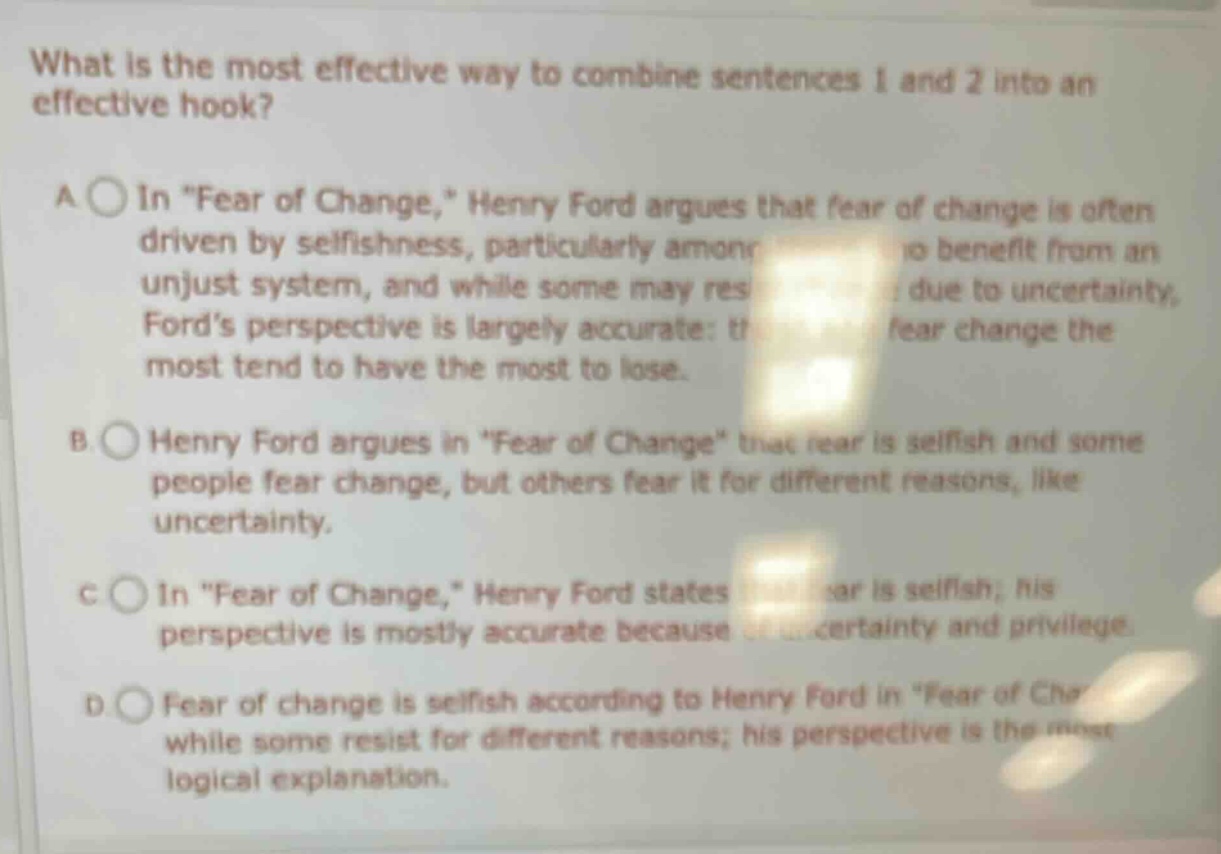
what is the most effective way to combine sentences 1 and 2 into an effective hook? a in \fear of change,\ henry ford argues that fear of change is often driven by selfishness, particularly among those who benefit from an unjust system, and while some may resist due to uncertainty, fords perspective is largely accurate: those who fear change the most tend to have the most to lose. b henry ford argues in \fear of change\ that fear is selfish and some people fear change, but others fear it for different reasons, like uncertainty. c in \fear of change,\ henry ford states that fear is selfish; his perspective is mostly accurate because of uncertainty and privilege. d fear of change is selfish according to henry ford in \fear of change,\ while some resist for different reasons; his perspective is the most logical explanation.
Answer
Brief Explanations:
A hook should be engaging and clearly present the main - idea. Option A effectively combines the key points about Henry Ford's argument in "Fear of Change", including the idea that fear of change is often driven by selfishness among those who benefit from an unjust system and also acknowledges other reasons for resistance. It is more comprehensive and well - structured compared to the other options. Option B is too simplistic, Option C is unclear in its connection between accuracy and uncertainty/privilege, and Option D makes an unsubstantiated claim about the "most logical explanation".
Answer:
A. In "Fear of Change," Henry Ford argues that fear of change is often driven by selfishness, particularly among those who benefit from an unjust system, and while some may resist due to uncertainty, Ford's perspective is largely accurate: those who fear change the most tend to have the most to lose.