proofreading - pop art\nread the passage and correct the errors.\nby the mid - to late 1950s, the world had…
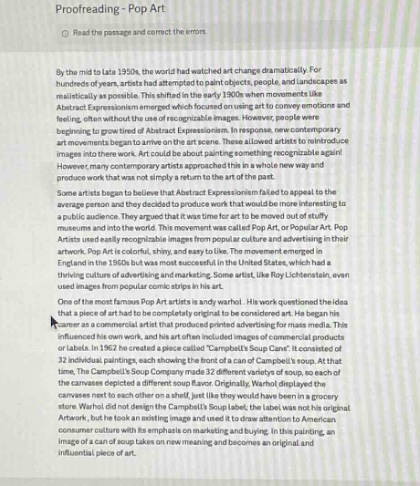
proofreading - pop art\nread the passage and correct the errors.\nby the mid - to late 1950s, the world had watched art change dramatically. for hundreds of years, artists had attempted to paint objects, people, and landscapes realistically as possible. this shifted in the early 1900s when movements like abstract expressionism emerged which focused on using art to convey emotions and feeling. often without the recognizable images. however, people were beginning to grow tired of abstract expressionism. in response, new movements emerged that focused on using recognizable images again. artists could be painting something recognizable again. however, many contemporary artists approached this in a whole new way and produce work that was not simply a return to the art of the past.\nsome artists began to believe that abstract expressionism failed to appeal to the average person and they decided to produce work that would be more interesting to a public audience. they argued that it was time for art to move out of stuffy galleries and into the public eye. they wanted to create art that was accessible.\nartists used easily recognizable images from popular culture and advertising in their artwork. pop art is colorful, shiny, and easy to like. the movement emerged in england in the 1950s but was most successful in the united states, which had a thriving culture of advertising and marketing. some artists, like roy lichtenstein, even used images from popular comic strips in his art.\none famous example of pop art is andy warhols campbells soup cans. warhol said that a piece of art had to be completely original to be considered art. he began his career as a commercial artist that produced printed advertisements for mass media. his influenced his own work, and his art often included images of commercial products or labels. in 1962 he created a piece called \campbells soup cans\. it consisted of 32 individual paintings, each showing the front of a can of campbells soup. each of the paintings was an almost identical copy of the others. warhol painted the soup cans so that the canvases depicted a different soup flavor. originally, warhols idea was that the canvases were to each refer on a shelf, just like they would have been in a grocery store. warhol did not design the campbells soup label; the label was not his original artwork, but he took an existing image and used it to draw attention to american consumer culture with his emphasis on marketing and buying. in this painting, warhol took a common object and gave on new meaning and became an original and influential piece of art.
Answer
Brief Explanations:
- "By the mid - to late 1950s" - This phrase is a bit awkward; it could be "By the mid - late 1950s".
- "artists had attemped" - The correct spelling is "attempted".
- "populary" - The correct word is "popularly".
- "Abstract Expressionism emerged which focused on using art to convey emotions and feeling" - "feeling" should be "feelings" for parallelism.
- "newcomers to the art world began to create art that incorporated images into there work" - "there" should be "their".
- "many contemporary artists approach" - The tense should be past - "approached" as the context is in the past.
- "Some artists began to believed" - "believed" should be "believe" after "began to".
- "they recognized it was time for art to be moved out of stuffy museums" - The passive "to be moved" is incorrect; it should be "to move".
- "used images from popular comics strips in his art" - "comics strips" should be "comic strips".
- "that a piece of art had to be completely original to be considered art" - This is a bit wordy; could be more concise.
- "he began his carrer" - The correct spelling is "career".
- "his work included images of commercial products of or labels" - "of or" is incorrect; should be "or".
- "each showing the front of a can of Campbell’s soup, at that time a populary - sold product" - "populary" should be "popularly".
- "the labels was not his original artwork" - "was" should be "were" as "labels" is plural.
- "but he took an existing image and used it to draw attention to American consumer culture with his emphasis on marketing and buying" - This is a long and a bit convoluted sentence but is grammatically correct.
- "and give it an entirely new meaning" - "give" should be "gave" to match the past - tense context.
Answer:
By the mid - late 1950s, the world had watched art change dramatically. For hundreds of years, artists had attempted to paint people, and landscapes as realistically as possible. This shifted in the early 1900s when movements like Abstract Expressionism emerged which focused on using art to convey emotions and feelings. Often without the recognizable images. However, people were beginning to grow tired of Abstract Expressionism. In response, newcomers to the art world began to create art that incorporated images into their work. Art could be painting something recognizable again! However, many contemporary artists approached this in a whole new way and produced work that was not simply a return to the art of the past.
Some artists began to believe that Abstract Expressionism failed to appeal to the average person and they decided to produce work that would be more interesting to a public audience. They argued that it was time for art to move out of stuffy museums and into everyday life.
Artists easily recognizable images from popular culture and advertising in their artwork. Pop Art is colorful, shiny, and easy to like. The movement emerged in England in the 1950s but was most successful in the United States, which had a thriving culture of advertising and marketing. Some artists, like Roy Lichtenstein, even used images from popular comic strips in his art.
Many people believed that a piece of art had to be completely original to be considered art. He began his career as a commercial artist that produced printed advertisements for mass media. His influenced his own work, and his art often included images of commercial products or labels. In 1962 he created a piece called "Campbell's Soup Cans". It consisted of 32 individual paintings, each showing the front of a can of Campbell’s soup, at that time a popularly - sold product. Warhol painted each can in a different color. Each of the canvases depicted a different soup flavor. Originally, Warhol's idea was that the canvases were to each refer to a shelf, just like they would have been in a grocery store. Warhol did not design the Campbell’s Soup label; the label was not his original artwork, but he took an existing image and used it to draw attention to American consumer culture with his emphasis on marketing and buying. In this painting, Warhol gave the label an entirely new meaning and became an original and influential piece of art.