rabbi dr. abraham twerski\ntheres something i want to tell you about the stress and how we have to look at…
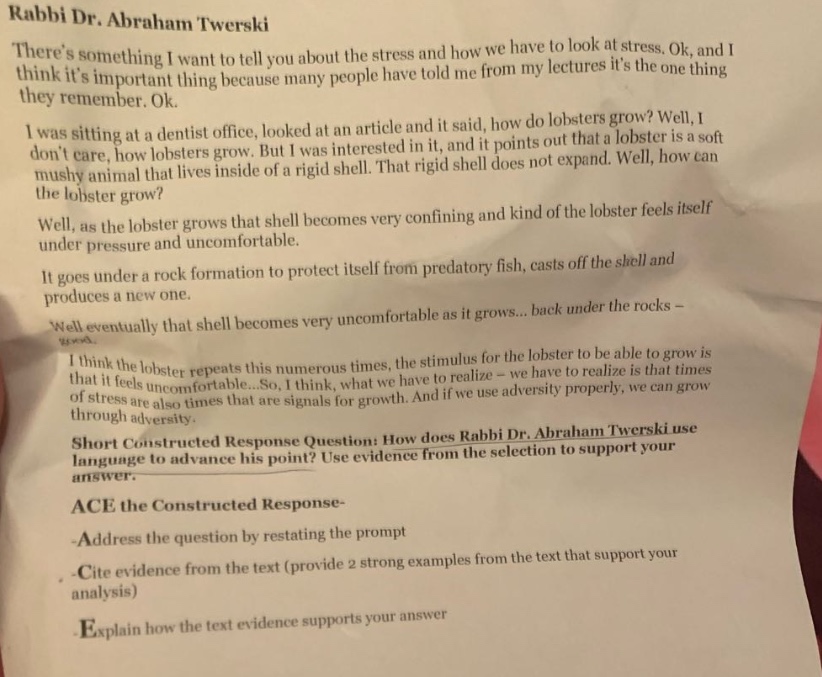
rabbi dr. abraham twerski\ntheres something i want to tell you about the stress and how we have to look at stress. ok, and i think its something i want to tell you about the stress told me from my lectures its the one thing theyre important thing because many people have told me from my lectures its the one thing to remember. ok.\ni was sitting at a dentist office, looked at an article and it said, how do lobsters grow? well, i dont care, how lobsters grow. but i was interested in it, and it points out that a lobster is a soft mushy animal that lives inside of a rigid shell. that rigid shell does not expand. well, how can the lobster grow?\nwell, as the lobster grows that shell becomes very confining and kind of the lobster feels itself under pressure and uncomfortable.\nit goes under a rock formation to protect itself from predatory fish, casts off the shell and produces a new one.\nwell eventually that shell becomes very uncomfortable as it grows... back under the rocks -\ni think the lobster repeats this numerous times, the stimulus for the lobster to be able to grow is that it feels uncomfortable...so, i think, what we have to realize - we have to realize is that times of stress are also times that are signals for growth. and if we use adversity properly, we can grow through adversity.\nshort constructed response question: how does rabbi dr. abraham twerski use language to advance his point? use evidence from the selection to support your answer.\nace the constructed response-\n-address the question by restating the prompt\n-cite evidence from the text (provide 2 strong examples from the text that support your analysis)\n-explain how the text evidence supports your answer
Answer
Brief Explanations:
Rabbi Dr. Abraham Twerski uses a metaphor of a lobster's growth process. He describes how a lobster outgrows its shell, feels discomfort and stress, and then sheds the shell to grow a new one. This is used to metaphorically convey that humans can also grow through stress and adversity. For example, "as the lobster grows that shell becomes very confining and kind of the lobster feels itself under pressure and uncomfortable" shows the lobster's stress - similar to human stress. Another example is "I think the lobster repeats this numerous times, the stimulus for the lobster to be able to grow is that it feels uncomfortable", which parallels human growth through discomfort.
Answer:
Rabbi Dr. Abraham Twerski uses a metaphor of a lobster's growth to advance his point. Evidence: "as the lobster grows that shell becomes very confining and kind of the lobster feels itself under pressure and uncomfortable"; "I think the lobster repeats this numerous times, the stimulus for the lobster to be able to grow is that it feels uncomfortable". The text evidence shows that just as the lobster's growth is spurred by discomfort and stress from its confining shell, humans can also grow through stress and adversity.