read the sentence.\ndigestion is divided into four parts, ingestion, digestion, absorption, and…
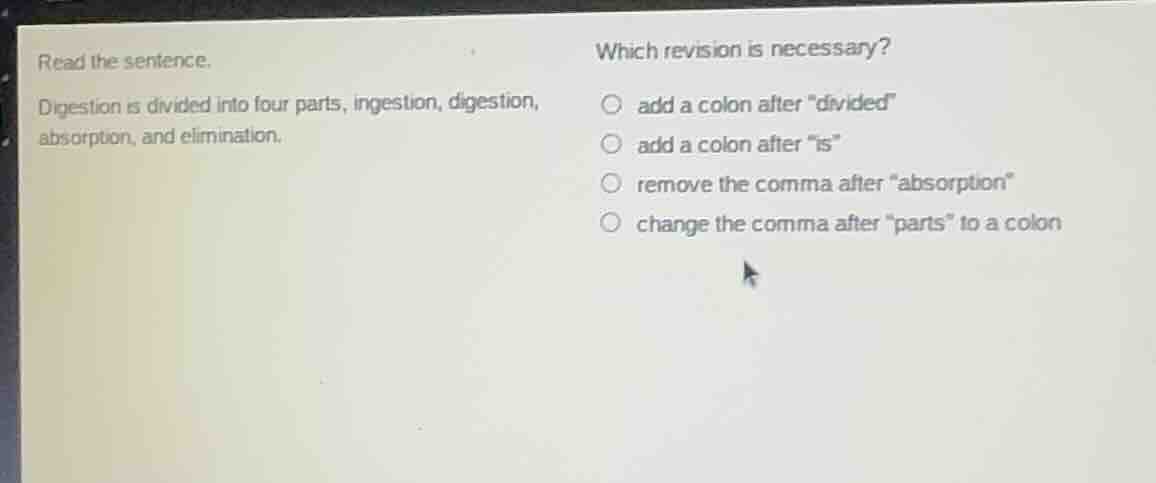
read the sentence.\ndigestion is divided into four parts, ingestion, digestion, absorption, and elimination.\nwhich revision is necessary?\nadd a colon after \divided\\nadd a colon after \is\\nremove the comma after \absorption\\nchange the comma after \parts\ to a colon
Answer
Brief Explanations:
In English grammar, a colon is used to introduce a list when it follows a complete independent clause. The phrase "Digestion is divided into four parts" is an independent clause that functions as a complete thought. Replacing the comma after "parts" with a colon correctly signals that a list of those four parts is about to follow. The other options are incorrect because colons should not separate a verb from its object or complement (as in "divided" or "is"), and the comma after "absorption" is a standard serial comma (Oxford comma) used to separate items in a list.
Answer:
change the comma after "parts" to a colon