rhetorical analysis\n\nelie wiesel asks his audience to consider an important concept: the \inescapable…
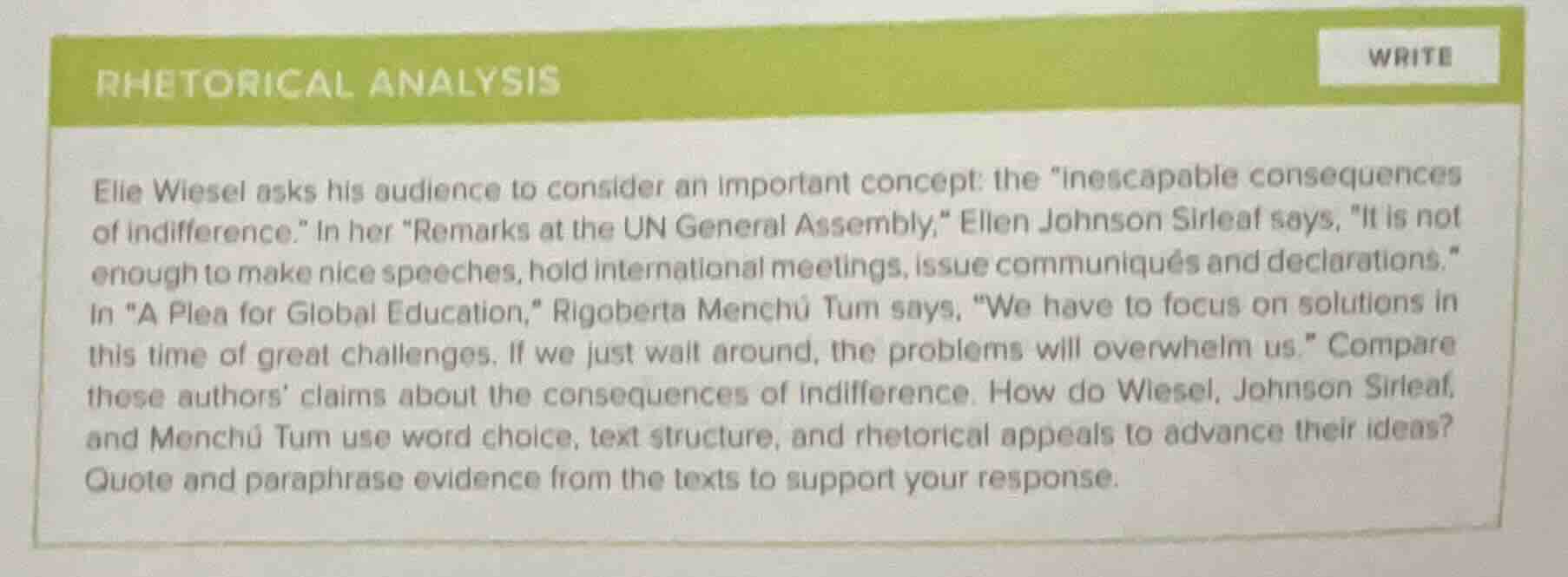
rhetorical analysis\n\nelie wiesel asks his audience to consider an important concept: the \inescapable consequences of indifference.\ in her \remarks at the un general assembly,\ ellen johnson sirleaf says, \it is not enough to make nice speeches, hold international meetings, issue communiqués and declarations.\ in \a plea for global education,\ rigoberta menchú tum says, \we have to focus on solutions in this time of great challenges. if we just wait around, the problems will overwhelm us.\ compare these authors claims about the consequences of indifference. how do wiesel, johnson sirleaf, and menchú tum use word choice, text structure, and rhetorical appeals to advance their ideas? quote and paraphrase evidence from the texts to support your response.
Answer
Brief Explanations:
The three authors argue that indifference and inaction lead to catastrophic outcomes, though they utilize different rhetorical strategies to convey this. Elie Wiesel uses poignant word choice like "inescapable consequences" to create a sense of moral urgency and inevitability (pathos). Ellen Johnson Sirleaf employs a parallel text structure, listing diplomatic activities like "nice speeches" and "international meetings" to contrast superficial gestures with meaningful action, appealing to logos by highlighting the insufficiency of current efforts. Rigoberta Menchú Tum uses a cautionary tone, warning that problems will "overwhelm us" if we "just wait around," which serves as a call to action (kairos) by emphasizing the immediate need for solutions. Collectively, they use these rhetorical appeals to shift the audience from passive observation to active engagement.
Answer:
Elie Wiesel, Ellen Johnson Sirleaf, and Rigoberta Menchú Tum all claim that indifference is a dangerous catalyst for failure and suffering. Wiesel uses the phrase "inescapable consequences" to emphasize the moral weight of apathy. Sirleaf structures her argument by contrasting performative diplomacy—"nice speeches" and "declarations"—with the tangible results required for change. Menchú Tum employs a sense of urgency, stating that without a "focus on solutions," the magnitude of global challenges will "overwhelm us." Through these choices, the authors appeal to the audience's logic and emotions to demonstrate that silence and inaction are not neutral, but destructive.